
Most homeowners approach a bathroom remodel as a finish selection exercise. They start with tile samples, vanity catalogs, and Pinterest boards. In the Seattle market, that approach produces failure within five to seven years. The Pacific Northwest climate imposes engineering requirements that have nothing to do with aesthetics, and ignoring them guarantees substrate rot, fastener corrosion, and microbial growth behind otherwise attractive surfaces.
A bathroom is the most demanding room in a residential structure. It combines pressurized water supply, gravity drainage, mechanical ventilation, electrical loads in a wet environment, and continuous thermal cycling. When you add Seattle’s ambient humidity profile and the building stock common to neighborhoods like Queen Anne, Magnolia, and Capitol Hill, the technical bar rises substantially. Anyone executing Seattle bathroom remodeling work needs to address these conditions at the rough in stage, not after the drywall closes.
Moisture Management in the Marine Climate
Seattle sits in a marine West Coast climate zone with strong marine influence. Outdoor relative humidity averages 75 to 85 percent for nine months of the year. Indoor air during the heating season holds 35 to 50 percent RH, and a single shower event pushes localized RH in the bathroom envelope above 95 percent within four minutes. The differential between interior wet zones and the cold sheathing behind exterior walls creates a continuous vapor drive toward the cold side.
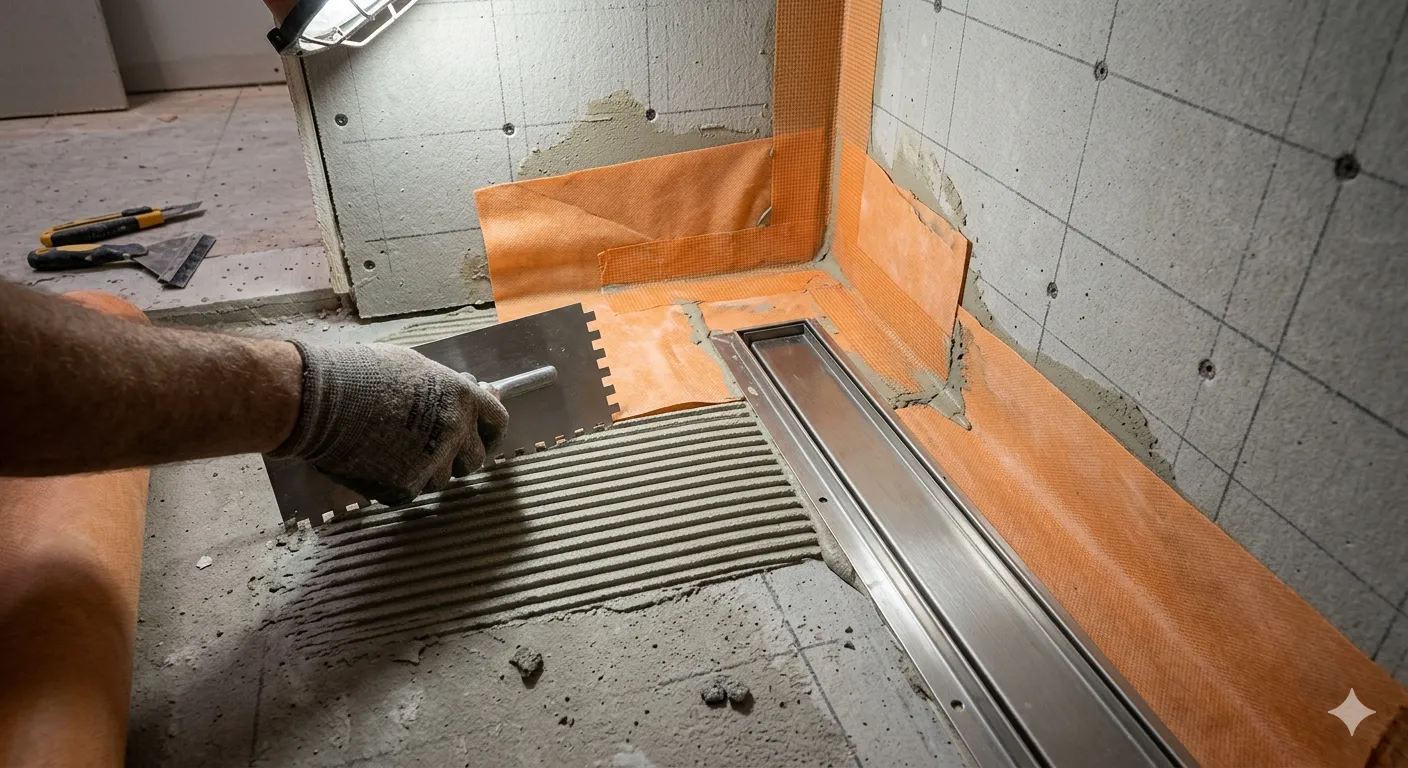
This is where most failures originate. A standard cement board and thinnest assembly is not a moisture management system. It is a tile substrate. Without a dedicated waterproofing layer applied to the surface of the substrate, vapor migrates through grout joints, saturates the cement board, wicks into the framing, and condenses on the back side of the exterior sheathing. The result is concealed decay that does not present until the subfloor deflects under the toilet flange.
Correct assembly requires a sheet applied or liquid applied waterproofing membrane bonded to the substrate, integrated with the drain flange and any penetrations. A capillary break between the slab or subfloor and the framing plates is non-negotiable. Mechanical ventilation must be sized to deliver a minimum of 50 CFM continuous or 80 CFM intermittent, ducted in insulated rigid metal to the exterior, never terminated in the attic.
Infrastructure First, Finishes Last
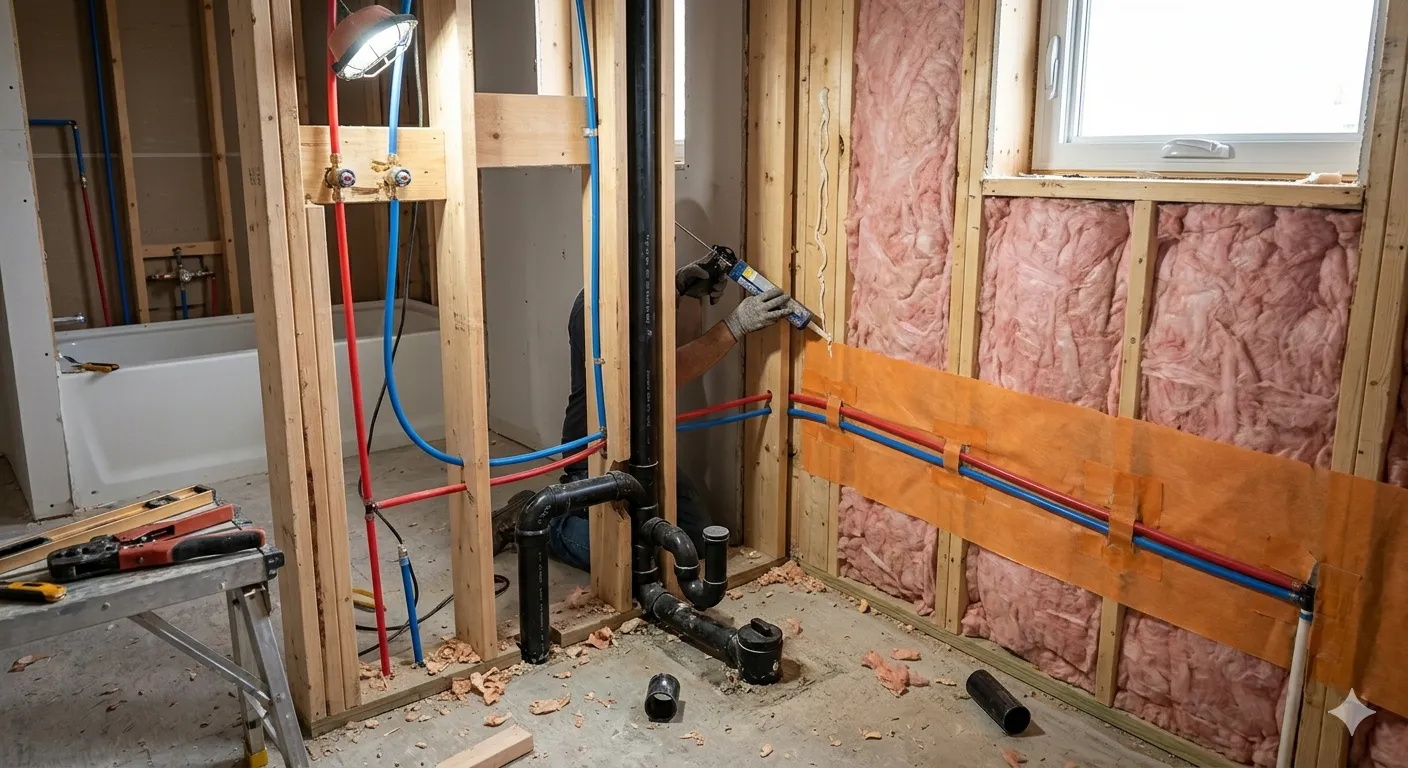
In homes built before 1965, which constitute a significant share of Seattle’s housing stock, the supply and drain infrastructure determines what is possible at the finish level. Galvanized steel supply lines from that era have lost 40 to 70 percent of their internal diameter to mineral deposition. Cast iron drain stacks develop horizontal scaling and pitting that reduces effective slope and traps solids.
Selecting a 12-inch rain head and a thermostatic mixing valve before verifying static pressure and dynamic flow at the fixture location is backwards engineering. If the supply main from the meter is three quarter inch galvanized with effective ID closer to three eighths, no fixture upgrade will perform. The correct sequence is: verify supply main condition, replace to PEX or copper as required, confirm DWV slope at one quarter inch per foot for two inch lines, relocate drains to match the new fixture layout, then specify finishes against the confirmed mechanical envelope.
Drain positioning is particularly unforgiving. A toilet flange set 12 inches off the finished wall accommodates standard fixtures, but a wall hung carrier or a comfort height unit with a concealed tank may require 13 or 14 inches and a different rough in elevation. Moving a flange after the slab pour or after the subfloor patch is expensive and frequently compromises the joist structure.
Single Source Accountability and the Two Week Model
The conventional remodel timeline of six to ten weeks is a function of trade fragmentation, not work content. When a general contractor coordinates an independent plumber, an independent tile setter, an independent electrician, and an independent cabinet installer, the project lives in the gaps between their schedules. Each handoff introduces a two to four day buffer, and any rework cascades through every subsequent trade.
A consolidated remodeling firm operating with in house plumbing, carpentry, tile, and electrical eliminates those handoffs. When the same operations manager controls the schedule and the same superintendent owns the quality control, a standard hall bathroom of 40 to 60 square feet completes in 10 to 14 working days. That is not a marketing claim. It is the output of a synchronized critical path where demolition, rough plumbing, rough electrical, inspection, insulation, substrate, waterproofing, tile, finish plumbing, finish electrical, and punch occur in a defined sequence with no idle days.
Clinical precision at this pace requires three conditions. First, every material must be on site and verified before demolition begins. Second, every dimension must be confirmed against the rough in drawings, not against the demolition assumptions. Third, the inspection windows with the Seattle Department of Construction and Inspections (SDCI) must be prescheduled and met without rework. Miss any of these and the schedule extends by a week per failure.
Wet and Dry Zone Separation
The final engineering requirement is layout discipline. A bathroom contains two functionally distinct zones: the wet zone, comprising the shower, tub surround, and the floor area within 24 inches of those fixtures, and the dry zone, comprising the vanity, toilet area, and circulation space. Treating these as a single environment is a common error that drives premature finish failure.
The wet zone requires waterproof substrates, sloped drainage, sealed penetrations, and finish materials with low porosity. The dry zone tolerates standard moisture resistant drywall, conventional flooring transitions, and cabinetry built with particleboard cores, provided the zone separation holds.
Effective separation depends on layout. The vanity should sit outside the shower spray radius, ideally on the opposite wall or at minimum offset by a partial wall or glass enclosure. The toilet should occupy a position where the supply line and waste line are clear of any wet zone substrate joints. Linear drains and curbless showers, when correctly engineered with the floor sloped at a quarter inch per foot toward the drain channel, contain water within the wet zone without relying on a curb.
Get these four conditions right and the bathroom performs for 25 years. Get them wrong and the finishes are cosmetic concealment over a structural liability.